June 27, 2014
by PharmaReviews
0 comments

Ramadan Message of Prof. Dr. Taha Nazir President Pakistan Pharmacist Federation

Very respected Pharmacists

Assalam-o-Alikum

Ramadan

With the grace of almighty Allah we have sufficient knowledge, experience and expertise related to the drugs and therapeutics. We belong to the noble and life saving profession of “pharmacy”. We can help and serve the sick humanity to get more and more reward, ajar and eventually the Junnah. Moreover; we have established Pakistan Pharmacist Federation to facilitate community to attain these objectives easy as possible. We also have got registration under society act 1860 by Government of Pakistan in this holy month of Ramada.

Thus; we should be kind to orphans and treat them with kindness. Do repent to Allah for sins and supplicate with raised hands at the times of prayer as these are the best times, during which Allah Almighty looks at His servants with mercy. Allah Answers if they supplicate, Responds if they call, Grants if He is asked, and Accepts if they entreat. O people! you have made your conscience the slave of your desires.

Ali ibn Talib (RAA) said: “I asked, ‘O messenger of Allah, what are the best deeds during this month’?” ‘He replied: ‘O Abu-Hassan, the best of deeds during this month is to be far from what Allah has forbidden’.” We (1.5 billion Muslims) are asked by Allah SWT to stay away from halal food and drinks and lawful conjugal relations from dawn to dusk for thirty days (out of 355 days) continuously and consistently.

I would also like to avail the opportunity to forward my to message to all executive members to;

1. Involve your self in praying and preaching of Quran and Sunnah.
2. Follow the Islamic preaching in real practical life.
3. Organize the individually and collectively iftars.
4. After Ramadan arrange “Eid Millan” Parties in your area of jurisdiction.

Furthermore; make it free by invoking Allah for forgiveness. Our back may break from the heavy load of our sins, so prostrate our self before Allah for long intervals, and make this load lighter. Understand fully that Allah has promised in His Honor and Majesty that, people who perform salat and sajda (prostration) will be guarded from Hell-fire on the Day of Judgment.

Please do not forget to make DUA’ for our brothers and sisters in Syria, Egypt, Bangladesh, Arakan (Burma), Palestine, Kashmir, Afghanistan and all around the world who have taken Allah SWT as their RAB(Lord), Muhammad (AS) as their prophet and Al-Islam as their way of Life (Deen) have been going through trials and tribulations. May Allah SWT give them SABR, give them guidance in this difficult time and give them help and victory over the Taghoot. Ameen and summa Ameen.

Wassalamu Alaikum wr-wb.


Prof. Dr. Taha Nazir
B.Pharm., M.Phil., Ph.D

President

Pakistan Pharmacist Federation
C.: 0321 222 0885;
E.:       tahanazir@yahoo.comW.:      www.pharmafed.wordpress.com            www.pharmareview.wordpress.com

June 25, 2014
by PharmaReviews
0 comments

Merck & Co inks $526M Alzheimer’s pact with Bionomics

PrintMerck & Co has linked up again with Bionomics, this time for Alzheimer’s disease, in a deal that could be worth over half a billion dollars to the Australian biotech.

The collaboration centres around BNC375, a compound which has displayed potent efficacy in animal cognitive impairment models. As well as Alzheimer’s, the alliance will look at other central nervous system disorders, including schizophrenia, ADHD and Parkinson’s disease.

Cashwise, Merck is paying $20 million upfront and up to $506 million for achievement of certain research and clinical development milestones, plus royalties. The US giant is also  funding all R&D and will be responsible for worldwide commercialisation of any products from the collaboration.

Rupert Vessey, head of early development and discovery sciences at Merck Research Laboratories, said the firm is happy to sign a new scientific collaboration with Bionomics, saying the latter’s “capabilities and overall expertise in discovery and characterisation of small molecules for this neuroscience target class is impressive”.

The firms first teamed up in July 2013 when they agreed to discover and develop small molecules for the treatment of chronic pain, including neuropathic pain. That deal could be worth up to $172 million, plus royalties.


June 24, 2014
by PharmaReviews
0 comments

Bayer bags rights to haemophilia A gene therapy

bayer-1p-w22Bayer has linked up with Dimension Therapeutics to develop a gene therapy for haemophilia A in a deal that could be worth about $250 million to the US biotech.

The German group has long been a major player in haemophilia A with its recombinant factor VIII (rFVIII) blockbuster Kogenate and earlier this year it unveiled plans to invest more than 500 million euros at two manufacturing sites to prepare for the production of two investigational treatments for the bleeding disorder. Now it will have access to a therapy “with the potential to significantly change the treatment landscape”,  according to Dimension chief executive Thomas Beck.
Dr Beck noted that currently-available replacement therapies for haemophilia A are often administered intravenously “multiple times a week and may be required for life, depending on the severity of a patient’s disease”. He added that inserting a correct version of the faulty gene responsible for the disorder could be transformational.

Dimension says that its adeno-associated virus vector technology allows for systemic intravenous administration of the clotting factor gene in vivo, which has been shown in preclinical studies to target the liver “resulting in long-lasting expression of FVIII protein at therapeutic levels”.

Cashwise, Bayer is making an upfront fee of $20 million and potential development and commercialisation milestone payments of up to $232 million, plus royalties. Dimension, which was only formed in 2013, will be responsible for all pre-clinical development activities and the Phase I/IIa study, with funding from Bayer, which will take over from there.

The bleeding disorder, which is largely inherited, has been attracting new players into the field of late. Biogen Idec received US approval earlier this month for its haemophilia A drug Eloctate (antihaemophilic factor [recombinant] Fc fusion protein) and for Alprolix (recombinant factor IX Fc fusion protein) for haemophilia B in March.

pharmatimes.com

June 24, 2014
by PharmaReviews
0 comments

Roche, Versant, Inception create ‘build-to-buy’ MS biotech

roche_logoRoche has hooked up with healthcare venture capitalist group Versant and research group Inception Sciences to create a new biotechnology company focused on developing treatments for multiple sclerosis.


Crowned Inception 5, the newcomer will dedicate itself to designing novel small molecule therapies that promote the remyelination of nerve sheaths damaged during disease progression, building on recent discoveries by researchers at the University of California, San Francisco.


Under the terms of the deal, Versant will stump up equity financing for the new company while Roche will fund the research based on a series of milestones.


Roche has option to buy

The Swiss drug giant also holds an exclusive option to buy Inception 5 when the first lead compound reaches the filing stage of an investigational new drug (IND) application.


“The unique deal construct lends itself well to exploring exciting, groundbreaking new science and jointly de-risking early stage research with Versant/Inception,” said Shafique Virani, Global Head of Neuroscience Partnering at Roche, explaining the firm’s interest in the deal.


With 12 investigational medicines in clinical development neuroscience is now a major focus of research and development at Roche. The group is also separately assessing the antibody ocrelizumab, which selectively targets CD20+ B cells believed to contribute to nerve damage MS, in a Phase III clinical program.

Source: pharmatimes.com

June 14, 2014
by PharmaReviews
0 comments

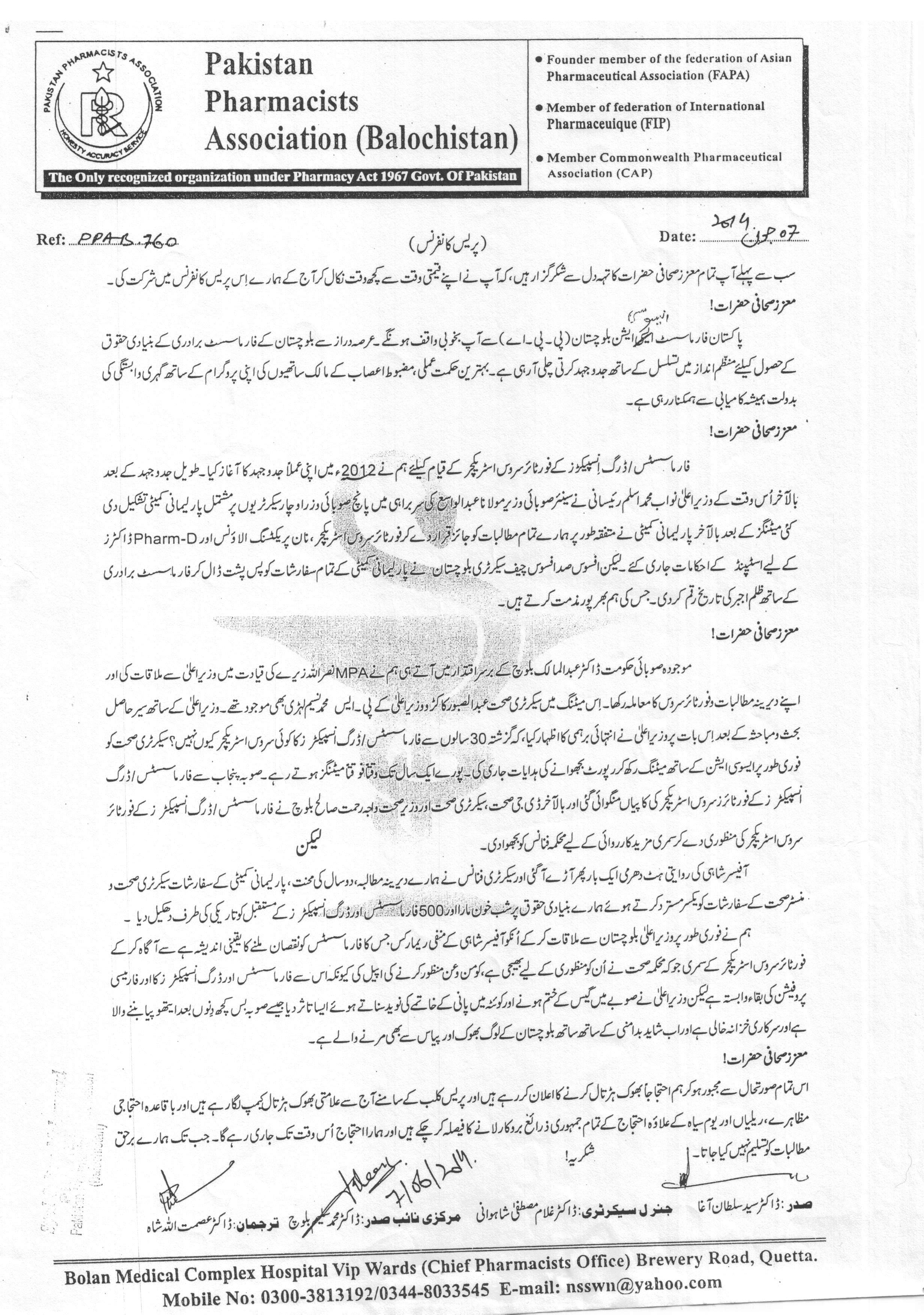
The executives of Pakistan Pharmacist Federation (PPF) has supported the strike/ protest camp of PPA Baluchistan regarding the service structure to provide the quality pharmaceutical care in province

Pharmaceutical Review (www.pharmareview.wordpress.com); Pakistan Pharmacist Association (PPA) Baluchistan is on strike and arranged a protest camp at Press Club, Quetta Baluchistan regarding provincial service structure . They are demanding the internationally recognized and WHO recommended service structure to provide the quality pharmaceutical care in province. They also have demanded the Provincial Health Allowance as per rule.

The executives of Pakistan Pharmacist Federation (Professional body registered under Society Act) have supported this strike. President: Dr.Taha Nazir B.Pharm., M.Phil., Ph.D., C.: 0321 222 0885; E. tahanazir@yahoo.com; Senior Vice President: Dr. Abdul Haleem Khan; B.Pharm., M.Pharm., Ph.D C.: +92 321 411 2410; Vice President (Hospitals): M. Ikram Khan B.Pharm. M.Phil., (NIH), Islamabad; Vice President (Marketing): Syed Jamshed Ahmed B. Pharm., MBA., M. Phil., Ph.D., C.: 03008257351; Tel: (021) 4315195-7 Ext. 112; Vice President (Industries): Hafiz Muhammad Umer Nisar Pharm D., M.B.A., C.: +92 300 478 0439; Vice President (Research) Dr. Tahir Aziz Mughal C.: +92 321 488 7801; General Secretary: Muhamamd Bin Ibrahim, B.Pharm., M.Phil. (Pharmaceutics), +92 300 780 9397; Joint Secretary Prof. Iradat Hussain B.Pharmacy, M.Phil., C.: 03214706508; President Sindh Br. Arif Arain (Sindh) +92 300 301 9512; President Punjab: Br. Abdul Aleem (Punjab) +92 301 718 3126; 0322 608 8647; President Baluchistan: Br. Ghulam Razzaq (Baluchistan) +92 333 783 6471; President KPK: Br. Mudassar Khan (KPK) +92 314 907 6915 has condemn the Baluchistan Govt. for not contacting and talking with pharmacy professionals. The chief secretary of Baluchistan Mr. Baber Fateh Muhammad Yaqood is actual person who has retained the case. Mr. Baber Yaqood told that they don’t have sufficient funds to implement the pharmacy structure. But, PPF and PPA Baluchistan have chalked out the financial scheme too to proved best health facilities for province. Hence; executives of PPF has demand to Dr. Abdul Malik Chief Minister of Baluchistan to enforce the service structure. This service structure is a blessing for general community, because it will cover the all aspects of all clinical and pharmaceutical care. The pharmacy professional will then be able to offer the basic pharmaceutical health care services of prescription review, patient counseling, therapeutical monitoring, pharmaceutical care, drug information, toxicology and poisoning control.

A quality community pharmacy practice will then help to pharmacy professionals to deliver their skills related to the drug dispensing, drug monitoring, patient biosafety, Pharmacovigilance, pharmaceutical care and therapeutical evaluation. This service structure will provide opportunity to staff pharmacists to minimize the clinical errors, therapeutic problems and remedial inaccuracies leading to save the precious lives of innocent patients enrolled in hospitals of Baluchistan. The standard pharmaceutical services may then be offered with all their features to improve the health care system in Baluchistan. That will help to prevent the unethical and commercially biased health care practice and encourage the rational drug usage. The pharmacists will then be considered as a focal person and important team member of health care system.


June 12, 2014
by PharmaReviews
0 comments

FDA Approves Eloctate – first Antihemophilic Factor, Fc Fusion Protein for Patients with Hemophilia A

The U.S. Food and Drug Administration today approved Eloctate, Antihemophilic Factor (Recombinant), Fc fusion protein, for use in adults and children who have Hemophilia A. Eloctate is the first Hemophilia A treatment designed to require less frequent injections when used to prevent or reduce the frequency of bleeding.

Eloctate is approved to help control and prevent bleeding episodes, manage bleeding during surgical procedures, and prevent or reduce the frequency of bleeding episodes (prophylaxis). Eloctate consists of the Coagulation Factor VIII molecule (historically known as Antihemophilic Factor) linked to a protein fragment, Fc, which is found in antibodies. This makes the product last longer in the patient’s blood.

“The approval of this product provides an additional therapeutic option for use in the care of patients with Hemophilia A,” said Karen Midthun, M.D., director of the FDA’s Center for Biologics Evaluation and Research.

Hemophilia A is an inherited, sex-linked, blood clotting disorder, which primarily affects males, and is caused by defects in the Factor VIII gene. Hemophilia A affects 1 in every 5,000 males born in the United States. People with Hemophilia A can experience repeated episodes of serious bleeding, mainly into the joints, which can be severely damaged by the bleeding.

The safety and efficacy of Eloctate were evaluated in a clinical trial of 164 patients that compared the prophylactic treatment regimen to on-demand therapy. The trial demonstrated that Eloctate was effective in the treatment of bleeding episodes, in preventing or reducing bleeding and in the control of bleeding during and after surgical procedures. No safety concerns were identified in the trial.

Eloctate received orphan-drug designation for this use by the FDA because it is intended for treatment of a rare disease or condition.

Eloctate is manufactured by Biogen Idec, Inc., Cambridge, Mass.

Source: FDA,drugs.com/news.html

June 12, 2014
by PharmaReviews
0 comments

Researchers uncover common heart drug’s link to diabetes

McMaster University researchers may have found a novel way to suppress the devastating side effect of statins, one of the worlds’ most widely used drugs to lower cholesterol and prevent heart disease. The research team – led by Jonathan Schertzer, assistant professor of Biochemistry and Biomedical Sciences and Canadian Diabetes Association Scholar – discovered one of the pathways that link statins to diabetes. Their findings could lead to the next generation of statins by informing potential combination therapies while taking the drug.

Approximately 13 million people, or half of those over the age of 40, could be prescribed a statin drug in their lifetime.

“Statins are among the most prescribed drugs in the world, and have been fantastic at reducing cardiovascular events,” Schertzer says. “But the side effects of statins can be far worse than not being able to eat grapefruit. Recently, an increased risk of diabetes has been added to the warning label for statin use. This was perplexing to us because if you are improving your metabolic profile with statins you should actually be decreasing the incidence of diabetes with these drugs, yet, the opposite happened.”

Schertzer’s group investigated further. “We found that statins activated a very specific immune response, which stopped insulin from doing its job properly. So we connected the dots and found that combining statins with another drug on top of it, Glyburide, suppressed this side effect.”

He says the finding has the potential to develop new targets for this immune pathway that do not interfere with the benefits of statins.

“It’s premature to say we are going to change this drug, but now that we understand one way it can cause this side effect we can develop new strategies to minimize side effects. This may even include using natural products or nutritional strategies to subvert the side effects of statins,” he says.

The next stage of their research is to understand how statins promote diabetes by understanding how they work in the pancreas, which secretes insulin. They also hope to better understand if this immune pathway is involved in other side effects of statins, such as muscle pain and life-threatening muscle breakdown.

Schertzer emphasizes that statins are important and widely prescribed drugs and understanding how they promote adverse effects may lead to necessary improvements in this drug class, which has the potential to affect a large segment of the population.

“With the new federal warning label on the risk of diabetes with statin usage, people are heavily debating its pros and cons. We think this is the wrong conversation to have. Statins are a great drug for many people. What we really should be talking about is how to make them better and we are beginning to understand the basic biology of statins so we can do just that. The next step for our work is to understand if all of the major side effects of statins occur by acting on this specific immune-metabolism pathway.”

Soure:worldpharmanews.com

June 9, 2014
by PharmaReviews
1 Comment

GSK launches huge Phase III trial for heart drug losmapimod

2

GlaxoSmithKline has begun a Phase III study cardiovascular outcomes study of its investigational compound losmapimod in patients with acute coronary syndrome.

The trial will assess whether losmapimod can reduce the risk of a subsequent cardiac event when administered orally twice a day for three months immediately after presentation with an ACS, such as heart attack. GSK says that some 25,500 patients will be enrolled over the study period across 39 countries.

Losmapimod is an anti-inflammatory that works by inhibiting the activity of p38, a mitogen-activated protein kinase. The latter is a type of enzyme associated with the acute inflammation that occurs in the blood vessels during and immediately after an ACS.

ohn Lepore, head of metabolic pathways and cardiovascular R&D at GSK, noted that changes in diet and lifestyle, “along with new approaches to treatment, have led to improved outcomes for patients with coronary artery disease”. However, patients who suffer a heart attack “remain at increased risk of a recurrent heart attack or other vascular event in the ensuing weeks and months”, he added, claiming that “the start of our losmapimod study is an important step forward in the search for innovative therapies aimed at reducing the recurrence of cardiovascular events”.

The push on lospamimod comes less than a month after another heart drug, darapladib, failed to show efficacy in a second Phase III trial.

Source: pharmatimes.com