
Ayaz Ali Khan
Chief Drug Controller
Health Department
Government of the Punjab, Lahore.
7-B, LDA flates, Huma Block, Allama Iqbal Town, Lahore.
Cell: 0300-8403646
Ph. Off. 042-37802422
Email: ayazalikhan@hotmail.com;
ayazalikhan1@gmail.com
Skype: ayazalikhan
Re.: Implementation of Pharmacy Services in Hospitals Reference Letter No. SO(DC) 6-6/2011(P), Govt. of the Punjab, Health Department Dated: 01/10/2012.
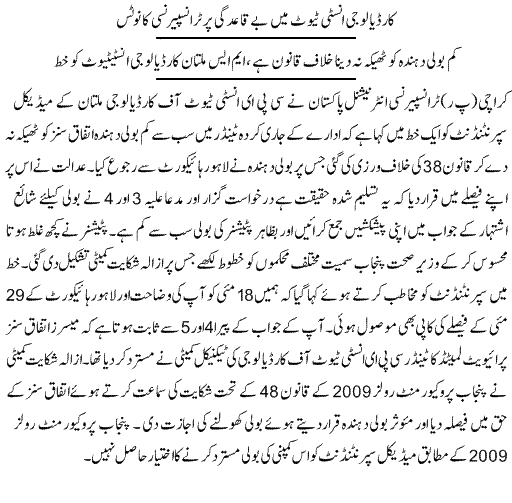
In response of your letter dated June 07, 2013, we would like to share some more information for betterment of pharmacy profession. We know; the Government of Punjab issued Notification No.SO(JUDL-III)9- 84/2012, under the West Pakistan Tribunals of Inquiry Ordinance, 1969 (the Ordinance). The Notification was issued pursuant to a request made by the Government of Punjab to the Chief Justice, Lahore, High Court Lahore, to appoint a Judge of the Court to conduct an inquiry pursuant to section 3 of the Ordinance. Mr. Justice Sheikh Azmat Saeed, the Honourable Chief Justice, Lahore High Court (as he then was), named me to assume the role of the Tribunal of Inquiry. The Tribunal of Inquiry was necessitated on account of numerous deaths being reported prima facie due to bone marrow suppression and other related complications amongst patients registered with the Punjab Institute of Cardiology (“PIC”), Lahore. The final and consolidated recommendations were compiled and distributed to address the issues as under;
- Recommendations Relating to Manufacturers/ Producers of Drugs
- Recommendations Regarding Distributors
- Recommendations for Investigating Agencies
- Recommendations Regarding Pharmaco-Vigilance & Poison Control Centers
- Recommendations Regarding PIC
- Recommendations Regarding
- Acquisition of Medicines
- Recommendations Regarding Administration of Hospitals
- Recommendations Regarding Monitoring & Upgrading Testing Laboratories
- Recommendations Regarding Licensing
Thus; in response of the “Report of the Defective Drug Inquiry Tribunal”, Health Department, Government of Punjab, Pakistan has issued a notification No. SO(DC)6-6/2011(P) dated 1st October, 2012 to establish pharmacovigilance centre, adverse drug reporting, drug information and poison control centre at provincial and hospital level. The notification is distributed to the Director General Health Services, Punjab; all Principals of Teaching Hospital and Institute of Punjab, all Executive District Officers (Health) Punjab; all Medical Superintendant, Special Instaurations & DHQ Hospital/ THQ Hospital in Punjab. The Report of the Defective Drug Inquiry Tribunal (Chapter 13) has given the recommendations regarding pharmaceutical/ clinical care, pharmaco-vigilance and poison control centers as under;
- Introduction of system of yellow slips for reporting Adverse Drug Reaction to the Hospital Committees set up for the said purpose.
- Setting up of Pharmaco Vigilance Centers at the level of the Health Department to process and share information regarding Drug Reactions and other related matters with health professionals/hospitals.
- Setting up of Poison Control Center at the level of the Health Department to maintain a database relating to poisons, data of medicines relating to adverse reaction, drug interaction data and other such information. The poison control center should be accessible to health professionals and hospitals. All major hospitals should be electronically linked inter se as well as with this center in order to share information of this nature.
- The Poison Control Center/ Pharmaco-Vigilance Center should have access to international database and should continuously update its database and information.
- A proper and well organized storage facility within the premises of PIC must be set up within the shortest possible time.
- A computerized inventory control and documentation system must immediately be introduced.
- A therapeutic committee consisting of top medical consultants of each discipline along with a pharmacist should be set up to develop a standard formulary, which should be updated from time to time.
- The ratio of pharmacists viz a viz patient must be increased to one pharmacist for each 50 beds in the hospital.
- The role of pharmacist needs to be specified and enhanced. The pharmacist must be given the responsibility to countercheck the prescription written by the consultants/medical doctors and conduct rounds of the wards with the consultants.
- The role of pharmacist in the pharmacy as well as the store needs to be specified and in this regard SOPs need to be put in place.
- The job descriptions of pharmacist should be specified in writing and handed over to the pharmacists performing functions in different departments in line with duties assigned to pharmacists internationally.
- The pharmacist should also play a major role in the process of acquisition, receipt and storage of medicines for the hospital. He must be a responsible member of the Committee.
- In case the hospital decides to set up a committee to prequalify suppliers, the Chief Pharmacist of the hospital must head such committee.
- There should be a separate hierarchy and service structure of pharmacists. It is also recommended that Government of Punjab should set up a separate directorate of Pharmacy to deal with service structure and all related matters involving pharmacists.
- An air conditional storage area for medicines should be set up within the hospital
Thus; initiation of implementation/ establishment of pharmacy services in hospitals are triggered by PIC incidence. Otherwise; it may not be an important goal of “Professional Group” of Pakistan Pharmacist Association (PPA). Additionally; the “Professional Group” is very poor representor of pharmacist community because of its poor electoral procedure and limited registrations (of Pakistan Pharmacist Association).
Moreover; now a days, it’s an excellent opportunity to enforce the pharmaceutical care and drug rules. But unluckily the professional group (existing stakeholder of Pakistan Pharmacist Association) is badly failed to facilitate pharmacist community in Pakistan. This group presently representing PPA in Punjab, Sindh, Gilgit Bultistan, Islamabad areas and centre has maintained its hold by certain unethical and non-professional course of actions since last 25 years. They even did not arranged the PPA election within the time frame defined in the “article of organization” to just prolong and enjoy the privilege of leading this noble profession. Thus; they did not care about the professional issues and has focused on their own businesses, job promotions, foreign tours etc. The failure of “Professional Group” is evidenced by not implementing the Punjab drug rule 2007; not assuring the issuance of the “drugs sale license” to pharmacist only; not designing; not establishing the independent “pharmacy directorate” to assure the independent working; not properly enforcing the “salary structure” to assure the minimum starting wage of new graduates equivalent to 17th grade gazetted officer; not assuring the “new recruitments and appointments” of pharmacists in trauma centre, TB centers, operation theatres, TPN, drug information centers and Aseptic dispensing to assure the rational utilization of life saving drugs, armed forces, naval hospitals, combine military hospitals (CMH’s) in uniform, Railways, WAPDA, PTV, PIA etc on permanent and regular basis with all benefits; not assuring the pharmacist as an “important team member” of therapeutical committees, drug purchase committees and clinical pharmaceutical services departments to play as life saving professional.
If you (along with your “Professional Group”) are really interest to promote pharmacy profession; then being Chief Drug Controller, Health Department, Government of the Punjab, Lahore, initiate the strive to;
- Ensuring the issuance of Drug Sale License to pharmacist only.
- Ensure the establishment/ implementation of pharmacy services
- Enforce the enforcement of drug rule 2007
- Advertise the vacant post in health department, Punjab etc
We shall support you by all the ways to establish aforesaid point. We; being executives of Pakistan Pharmacist Federation (https://pharmafed.com/Sakeholders.html) shall provide the resources, passions and time to establish pharmaceutical and clinical services. We will ensure the appropriate institutions and following the aforesaid direction of Punjab Health Department.
We look forward to discuss/ talk further to make effective and comprehensive move for professional advancements. You may reach us any time at https://pharmafed.com/Contact_Membership_Form.html if you have any query;
Thanks and regards;
Dr.Taha Nazir, B.Pharm., M.Phil., Ph.D, President, Pakistan Pharmacist Federation; C.: 0321 222 0885; E.: tahanazir@yahoo.com
Haji Muhammad Ayub B.Pharm., M.Phil., General Secretary, Pakistan Pharmacist Federation, C.: 0321 432 4743; E.: hajimuhammadayub1@gmail.com
 ReutersThe office of Swiss drug manufacturer Novartis in Basel, Switzerland.